
Three pro shops rebuilt their tracking. One cut losses by nearly 90%
Pro shops lose demo clubs when tracking depends on a bag-tag bin instead of a log. Fixing that habit can cut annual loss by nearly 90%, based on numbers from three pro shops that tracked the before and after.
Maggie Flerschutz could not stare at the bin anymore. Behind the counter at Baltusrol Golf Club, where she is Head of Retail, plastic bag tags went in whenever a member took out a demo driver.
In theory, they came back out when the driver did. In practice, they piled up, and some drivers never came back at all. The bag tags drove her nuts. "I couldn't look at it anymore," Flerschutz says.
That bin is where many demo club losses start. And the cost adds up fast.
The real cost of an untracked demo club program
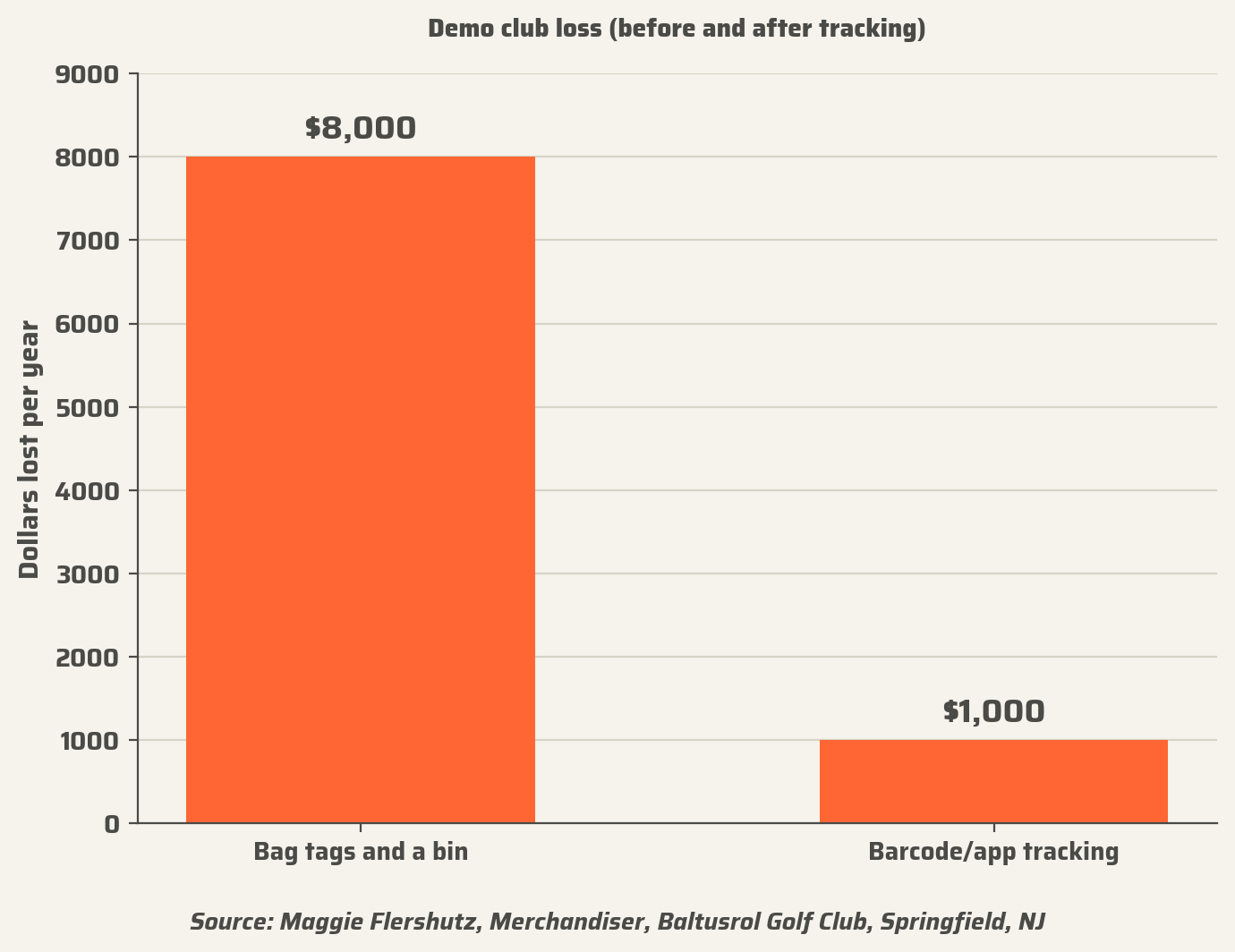
Flerschutz says annual demo club loss at Baltusrol amounted to about $8,000 before switching to a demo club tracking system. After the shop moved to Golf Genius Golf Shop, that number dropped to roughly $1,000, totaling nearly a 90% reduction by her own account, with no other process change.
During his first year running the program at Fiddlesticks Country Club in Fort Myers, FL, Head of Retail Justin Mack describes the pre-tracking losses in even blunter terms. He says "thousands of dollars" came straight off the bottom line in lost demo clubs, with no way to explain the loss to the GM beyond, "Yep, we lost them."
At Mizner Country Club in Delray Beach, the pain wasn't just the sunk cost. Mizner's assistant pro Connor Mulcahy says the shop runs more than 900 demos a year, and the time added up too.
When tracking is a manual process, employees can lose hours looking for clubs. "You're always thinking they're gonna turn up, and then they don't," Mulcahy says. Before the shop moved to a demo club tracking system, more than one XXIO driver disappeared for good.
The 8 steps to a demo club program that tracks itself
1. Standardize your naming convention before the season
Store the description of every driver, wood, and iron set the same way every time (brand, loft, flex, in that order), and you can find a club in seconds. A new hire onboarding the stock learns a naming convention by building it.
2. Check clubs in and out through the app or a barcode scanner, not a shared login
A demo club checkout should take three or four taps. If it's taking longer, the bottleneck could be a shared front-counter login rather than the software. Individual logins can turn the response to the question "Who had this club?" into an answer instead of a guess.
3. Set a due date on every checkout and let automated reminders take care of the follow-up
One shop defaults to a one-week window. Another varies the window by how much of that SKU is in stock. Nobody on staff has to call a member and say, "Hey, I think you still have that club." Mack, Mulcahy, and Flerschutz all independently described that conversation as the worst part of the old process.
4. Track mixed heads and shafts separately, with notes
There is also the hardware of the demo club to consider. An interchangeable driver head means a shaft can sit in the demo bag for days with no head attached, and vice versa. A Notes field that records "10.5° head out with Member X, shaft in bag" prevents you or a pro shop employee from standing in the demo rack later wondering what happened to the other half of the club.
5. Be deliberate with your reset cadence
Some pro shops wipe the entire demo inventory clean every offseason and rebuild it as new stock arrives. It's the kind of clean slate that also functions as a physical inventory count, and lets a new intern "start from ground zero," as Mulcahy puts it, to learn the system while they rebuild it.
Other pro shops simply update descriptions in place (e.g., last year's 10.5° Elyte driver becomes this year's Quantum) and never clear the list. Both can be defensible moves. To Mulcahy, what is indefensible is a demo club sitting overdue by three years.
6. Decide whether fitting-cart stock lives inside or outside demo inventory
One shop keeps fitting and demo completely separate, in different buildings. Another intentionally blends them so a member can take a fitting-cart head out onto the course. Again, either can be correct. The mistake is leaving it undecided. That's how heads and shafts start disappearing from a system nobody agreed to track in the first place.
7. Pull demo history before every special order conversation with a member
If a member calls back six months later wanting to buy the exact driver they demoed, the specs are already logged. No re-asking, no guessing at the shaft flex they liked. It also flags which demo clubs actually convert to sales, useful information that can influence next year's demo buy.
8. Review your demo club program history monthly (not just when something's missing)
A monthly review of your shop's checkout history does more than catch what's missing. Staff accountability improves when everyone knows their name is attached to every checkout. It also makes the conversation with a GM about shrinkage a data conversation instead of an apology.
What disappears when you start demo club tracking
Most shops treat demo loss as a money problem. The operators who fixed it describe the payoff differently. It's about what stops happening in your pro shop. The awkward phone calls stop. The bin behind the counter disappears.
When a member says, "I already returned that," the shop can pull up the log and know whether that's true, and to what extent. At Baltusrol, the bin behind Flerschutz's counter is gone for good.
Golf Shop tracks demo check-ins and check-outs, due dates, and member history in one log your whole staff shares.