
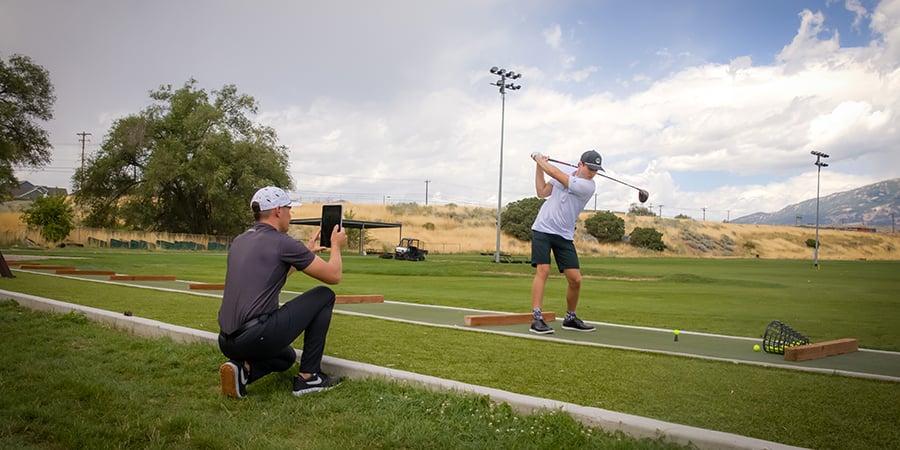
A standalone video clip rarely moves the needle. Video feedback only improves a golfer's game if the student can take action from the footage. Most coaches shoot video; the real skill is closing the gap between the clip and the action it should trigger.
Joe Hallett (2024 PGA Coach of the Year) learned this the hard way long before video was easy. Back when feedback meant handing out VHS tapes, he found the format didn't even matter if the habit around it didn't work: "The student never ever put it in their VHS machine and looked at it. They had no way to look at it on the course."
Video feedback is only useful when it is more than just a collection of videos taking up storage space in a phone. Here are six habits real coaches use to ensure their video feedback is actionable.
1. Remove friction first
If capturing and sharing video becomes a hassle, coaches won't do it consistently — and inconsistent feedback can't build progress. Doug Hammer, director of instruction at Troon North, remembers what friction used to cost him.
His old camera-and-tripod setup took "20 to 30 minutes to set up," enough to make him question whether it was worth it for two or three lessons on a light day. Then, he'd lose another hour burning CDs to get footage to students.
When capturing and sharing a swing takes seconds from a phone in hand, coaches can do it every lesson. That's the kind of consistency that is the foundation of true progress.
2. Context over clips
A video with no context is little more than a puzzle without an answer key. But a video with context can be a true coaching moment. Hammer sets the expectation directly with students: "Do post a video. I want to know some information. Don't just post videos for me. Tell me what's going on."
What the student felt and what they were working on can tell a coach where to take them next. No video or note can change a student's relationship to their own practice; only reflection can. They have to think about what they're feeling before they hit send, which sharpens their own self-diagnosis over time.
3. Say the same thing many ways
Actionable feedback is also about finding the explanation that works for the student. There's no one perfect explanation for every swing. Mike Dickson, a Golf Magazine Top 100 PGA professional, is blunt about the math — "You'll explain to tell people ten different ways for people to be able to hopefully hear it one way that makes sense."
Two students with the identical fault often need two completely different explanations to feel it. His fix: a tagged drill library. A searchable library means your best explanation of an adjustment is never more than a click away.
Grip, grip pressure, and the rest — the right version is just a search away. "This is the grip one I want. Oh, and then this is grip pressure. I want to do that one too."
4. Create an indisputable swing
One of your students struggling at a tournament sends over a clip and asks for help. Instead of reacting to it in isolation, you can pull a swing from six months earlier when the player was sharp.
"Your takeaway was way inside compared to how you were swinging," says Hallett. The comparison does the convincing — and then the student can buy into whatever it is you're talking about.
Drew Kiger, a PGA professional based in North Carolina who built his golf academy from the ground up, keeps a swing database for long-term students dating back to age six or seven. The most persuasive feedback is to analyze today's swing alongside a better swing video from the student's archive. When a player's game slips, the evidence of what 'good' looked like might already be there, and the coach can show the student from any stage of their journey.
5. Make the fix unmistakable with voiceover & overlay
A picture is worth a thousand words, and a clearly traced line is clearer than any sentence could ever be. A voice walking through it is even clearer. Kiger builds this into everyday lessons. A student with a weak grip gets before-and-after images with arrows showing change, a voiceover review, and an overlay comparing the two positions.
The student doesn't have to remember what the coach said because they can watch the coach say it, as many times as it takes. That's the gap between 'strengthen your grip' as a spoken note, and a 15-second clip showing the exact hand position in the coach's own words.
6. Let technology nudge you in the right direction
AI is moving fast in the world of swing video analysis, and most coaches leveraging this tool are clear about where they draw the line.
Hallett lays out the version he actually wants: a prompt that surfaces something in a student's stats or launch data — "Hey, we found something" — so the coach looks timely and sharp. But he's specific that it "doesn't necessarily solve the answer." It points. The coach decides.
As the coach, you bring the read, the relationship, and the fix. So embrace technology. Let technology nudge you in the right direction without replacing you. A tool can find a pattern faster and lead to positive change faster.
What actionable feedback really means
Feedback students share four traits: it's captured without friction, carries context, meets the student where they hear it, and lives somewhere they can return to it.
Dickson describes a lesson on trail-leg flex — rope drill, board drill, a run of different feels — all captured in the student's account. In his own words, Dickson 'takes that all away'. Skip this step, and the outcome looks different: [the student] "just goes away from it and tells his buddy, like, I don't know, we're just trying to keep my right hip in or something."
Same lesson. Two different outcomes. The only variable is whether or not the feedback followed the student home.
Coaching that never clocks out
A junior golfer can miss a swing thought three weeks after the lesson. With CoachNow, she doesn't have to remember. The video, the drill, the context. It's all still there, and still hers.
Your best feedback doesn't stay on the lesson tee. It should go home with your students. That's the difference between coaching that simply 'happens' and coaching that lasts.
