
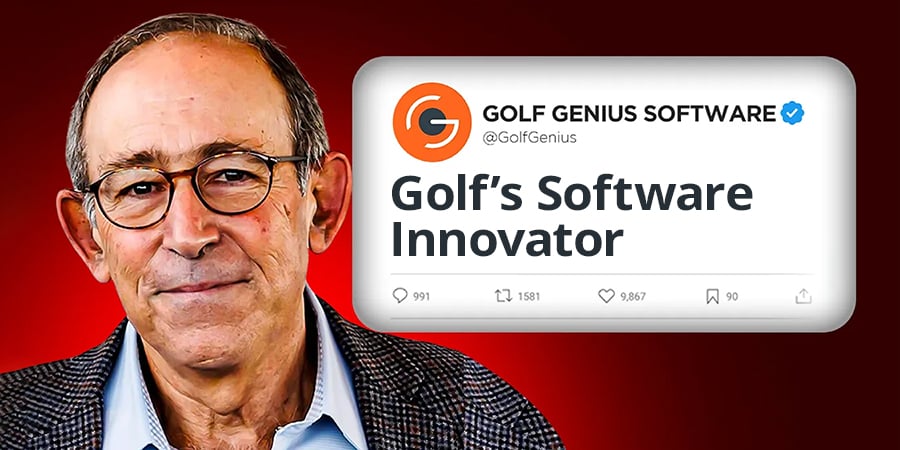
Golf Genius founder Mike Zisman sat down with Rohit Malhotra on the Life Self Mastery podcast to discuss how Golf Genius grew from an idea into a platform for tournament management, pro shops, coaches, and golfers, used by more than 11,000 golf clubs in 62 countries.
Mike believes relationships win in golf. The clearest example is the USGA deal he says transformed the company. When the USGA moved its tournament management to Golf Genius, he wrote the contract so the USGA could get out if it didn’t work. The USGA stayed.
The conversation also covers partnerships, employee ownership, and AI. Each one shapes the software that clubs, associations, and golf professionals use every day.
Does the USGA use Golf Genius?
Yes. The USGA replaced its tournament management system with Golf Genius. Mike says Golf Genius now handles all the handicapping in the US.
Getting in the door took a tip.
The USGA was spending heavily with an outside firm to rebuild its old desktop system when a senior figure at a Metropolitan Golf Association dinner told Mike there was a window and whom to contact.
This led him to Sarah Hirshland, then at the USGA and now CEO of the U.S. Olympic & Paralympic Committee. She told him the USGA could find companies that knew golf, and companies that knew software, but couldn’t find any that knew golf software.
“Our relationship with the USGA really transformed the company… We built a trusting relationship and wrote a contract that gave them a lot of flexibility to get out if it didn’t work. And it’s been a fantastic relationship.”
The tournament system the USGA chose also runs club championships, member-guests, and weekly leagues. Golf Genius builds for the rest of the club too: Golf Shop for the pro shop, CoachNow for coaches and students, and Golfshot and SwingU for golfers.
Why does Mike Zisman say relationships matter in golf?
Golf is a community business. Clubs talk to other clubs, and associations talk to their members. Reputation travels fast and carries weight.
When asked whether relationships still matter in the age of AI, Mike says “absolutely yes.”
His PhD thesis was in artificial intelligence, and he still encouraged his four kids to study the liberal arts, because he believes the two things employers want are communication and critical analysis.
Golf Genius relies on partners for some of the software clubs need. Mike explains it this way:
“You don’t have to build all that stuff… but it requires partnerships. Could we build that? Of course we could. But why would we? So partnerships become very, very important.”
From the start, Mike focused on understanding how golf clubs operate. He served on the board of Merion Golf Club for years. Golf Genius now employs about 80 PGA professionals, all of whom came from clubs. Mike believes that the best golf software starts with the people who run the club.
Who uses Golf Genius?
Clubs buy Golf Genius, and their members use it. Golf Genius started with golfers.
Mike says he was always the one organizing his annual buddy golf trip: 16 golfers, five rounds. At the end of every trip, someone would come to him with a concern. He’d been paired three times with someone he didn’t like and never with the friend he wanted.
Mike had loved scheduling problems since graduate school, and he recognized this as one. He built the software to solve it.
Golf Genius launched in 2010 as software for golf trip organizers. That market proved too small, so the company moved to golf leagues and, by 2014, to clubs. Golfers still sit at the center of the business, which Mike describes as B2B2C:
“Although we were B2B, we’re really B2B2C. Merion Golf Club is our customer, but it’s the members at Merion Golf Club who use our software, who have our app on their phone, who know us.”
Why does AI matter to Golf Genius?
Mike says AI tools are now essential for any company building software:
“Today it’s even more: ignore AI at your peril… If you’re not using AI tools to build products, you’ll get run over.”
How is Golf Genius built to last?
In Golf Genius’s early years, whenever the company needed more money, Mike talked it over with his wife and put it in himself. Golf Genius became profitable on that funding and has raised little from outside investors since.
That approach shaped how Golf Genius runs today:
- Employee ownership. Raising little let Golf Genius make its employees owners. Mike says his joy now comes from watching other people succeed.
- No office. Mike built Golf Genius to run without one from the start. Its development team in Romania, about 130 people, keeps 96% retention in a city with 3,200 software companies.
- Acquisitions aimed at golfers. After deciding in 2023 to reach golfers directly, Golf Genius bought two golfer apps, Golfshot and SwingU, and is now bringing them together.
For clubs, this kind of retention means the people building Golf Genius tend to stay.
Listen to the full episode
The full conversation runs about 55 minutes. Here’s where to jump in:
|
Time |
Topic |
|
7:56 |
The buddy golf trip that started Golf Genius |
|
12:07 |
How the USGA partnership happened |
|
14:10 |
Why relationships still matter in the age of AI |
|
16:29 |
Raising as little money as possible |
|
22:08 |
Building a remote team in Romania |
|
24:29 |
Spreading ownership across employees |
|
26:44 |
Why Mike says to ignore AI at your peril |
|
33:22 |
Moving into the golfer market |
|
51:46 |
Learning how golf clubs operate |
Watch the full episode on YouTube, or find it on the Life Self Mastery site, Apple Podcasts, or Spotify.